A filling repairs a cavity inside a tooth with strong walls, while a crown covers a tooth too weak or cracked to hold one.
The deciding factors are how much healthy tooth remains, whether a cusp is cracked or broken, and whether the tooth has had a root canal. In DC, a back-tooth filling runs $300 to $441, and a ceramic crown about $2,050.
Key Highlights
- Fillings fit small and medium cavities in teeth with strong walls.
- Crowns fit broken cusps, large failing fillings, painful cracks and back teeth after a root canal.
- In DC, a back-tooth filling costs $300 to $441, and a ceramic crown about $2,050.
- Fillings with more surfaces fail more often, mostly from new decay and fractures.
- In a study of 2,858 cracked teeth, more than 98% were still in place after three years.
In this article
- Crown vs filling: the main differences
- How your dentist decides
- When a filling is enough
- When you need a crown instead of a filling
- What about an onlay?
- Crown vs filling cost in DC
- Cracked tooth: crown or filling?
- Crown vs filling FAQ
Crown vs filling: the main differences
The biggest difference is coverage. A filling replaces only the part of the tooth that decay destroyed, and a crown covers the whole visible tooth down to the gumline.
| Filling | Crown | |
|---|---|---|
| What it does | Seals a cavity inside the tooth | Covers and holds the whole tooth together |
| Tooth removed | Only the decay | A thin layer on every side |
| Best for | Small to medium cavities, strong walls | Weak or broken walls, cracks, root canal teeth |
| Visits | 1 | Usually 2, with a temporary crown in between |
| Back tooth cost in DC | $300 to $441 | About $2,050 |
| Insurance category | Usually basic | Usually major |
How your DC dentist decides
Dr. Hoang looks at the tooth, the X-rays, and your bite before recommending either one.
These are the questions that decide it:
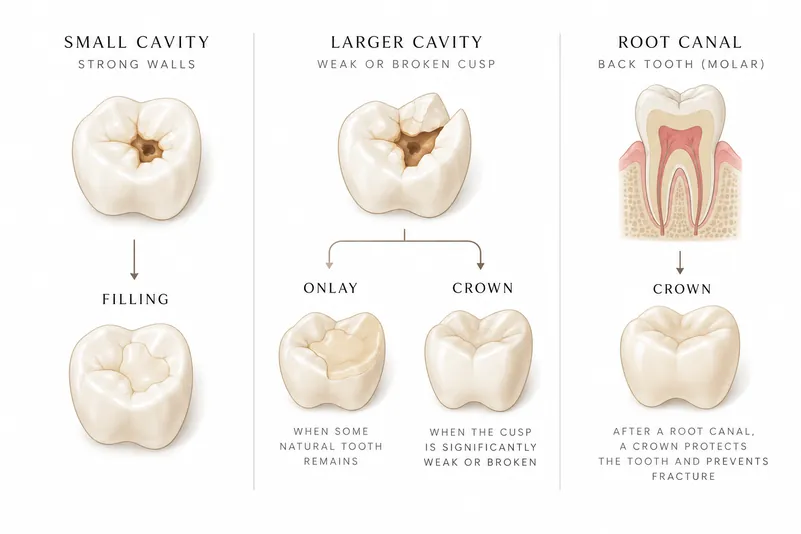
- How much healthy tooth is left? Thick, supported walls can hold a filling. Thin walls flex under biting and can break.
- Are the cusps intact? Cusps are the raised points on back teeth. A cracked or missing cusp needs coverage.
- How big is the old filling? A large filling that keeps failing leaves less tooth to work with each time.
- Is there a crack? A crack line, pain when biting, or a broken piece changes the plan.
- Has the tooth had a root canal? Back teeth almost always need a crown afterward.
- How hard is your bite? Molars take the most force, and grinding adds more.
Size matters for a filling's lifespan. A review of 2,816 back-tooth fillings in the Journal of Dental Research found that fillings covering more surfaces failed more often. New decay and fractures caused most failures.
Insurance companies use similar rules. One insurer's clinical policy covers crowns for broken cusps, extensive decay, large failing fillings, root canal teeth, and cracked teeth with symptoms.
The same policy denies a crown when the cheek-side and tongue-side walls of the tooth are intact.
When a filling is enough
A filling is usually the right call when:
- The cavity is small or medium.
- The walls around the cavity are thick and solid.
- No cusp is cracked or broken.
- The tooth has no root canal.
- A small chip sits on the edge of a front tooth.
Tooth-colored fillings at DC Dental Spa are mercury-free.
When you need a crown instead of a filling
A crown is the safer choice when:
- A cusp is cracked or has broken off.
- An old filling covers most of the chewing surface and keeps failing.
- Decay has spread wide across the tooth or under an old filling.
- A cracked tooth hurts when you bite.
- A back tooth has had a root canal.
- The tooth is worn down from grinding.
After a root canal, a back tooth breaks more easily. A 2022 study followed 71,283 root-canal-treated teeth in US practices. A crown was linked to 5.3 more years of median tooth survival.
Crowns also hold up well over time. A 2015 review in Dental Materials found that about 95% of single crowns were still in place after five years.
Ask about a dental crownWhat about an onlay?
An onlay sits between a filling and a crown. It covers the weak cusps and leaves the healthy parts of the tooth alone.
An onlay can fit when:
- One or two cusps are weak, but the rest of the tooth is strong.
- The cavity is too wide for a filling.
- Keeping more natural tooth matters to you.
In DC, a porcelain onlay costs about $2,100, close to the price of a crown. Choose an onlay to keep more natural tooth, since the savings are small.
Crown vs filling cost in DC
A filling costs a fraction of a crown. Filling prices climb from one surface to three, then level off.
| Treatment | DC typical charge | DC insurance allowed amount |
|---|---|---|
| Tooth-colored filling, back tooth, 1 surface | $300 | $180 |
| Tooth-colored filling, back tooth, 2 surfaces | $361 | $216 |
| Tooth-colored filling, back tooth, 3 surfaces | $441 | $270 |
| Tooth-colored filling, back tooth, 4 or more surfaces | $438 | $265 |
| Porcelain onlay, 4 or more surfaces | $2,100 | $1,201 |
| Ceramic crown | $2,050 | $1,281 |
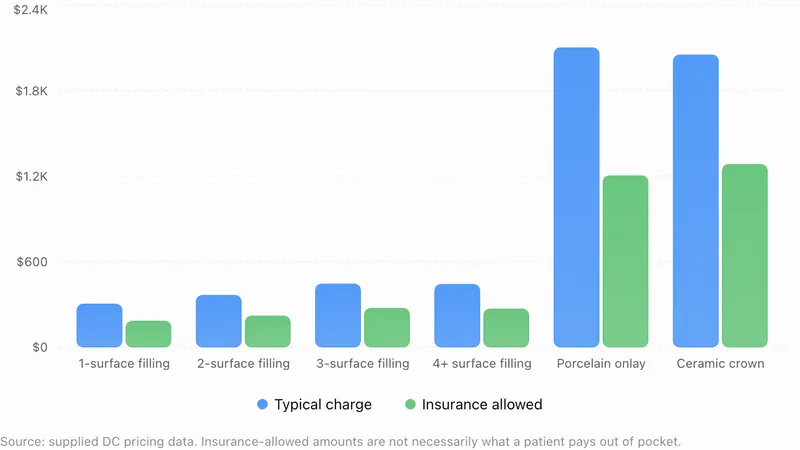
The typical charge is the median price billed to uninsured and out-of-network patients in the 20037 ZIP code, based on FAIR Health claims data. The allowed amount is the median price insurers recognize.
Insurance usually pays more for a filling than a crown. Fillings fall under basic care, and crowns fall under major care.
A crown costs more upfront. A large filling that cracks the tooth can lead to a crown, a root canal, or an extraction later.
Cracked tooth: crown or filling?
A crack does not always mean a crown. Many cracked teeth only need watching.
A National Dental Practice-Based Research Network study followed 2,858 patients with a cracked back tooth for three years. Here's what it found:
- More than 98% of the cracked teeth were still in place after three years.
- About 80% of teeth first set for monitoring stayed on monitoring the whole time.
- Treated teeth failed more often when they had a filling than when they had full or partial coverage.
A crack with no pain and no spreading can often be watched. A crack that hurts usually needs a crown.
Red flags:
- Sharp pain when you bite down or let go
- Pain with cold that lingers
- A piece of tooth that breaks off
- Swelling in the gum near the tooth
Call the office if you notice any of these. DC Dental Spa sees dental emergencies, and the phone line is answered 24 hours a day.
Why do dentists push for crowns?+
A dentist recommends a crown to stop a weak tooth from breaking. A tooth that splits below the gumline may not be savable.
You can ask to see the x-rays and photos of the tooth. Ask which cusps are weak and what happens if you wait.
Can I ask for a filling instead of a crown?+
Yes, you can choose a filling, and your dentist should explain the risks. A large filling in a weak tooth is more likely to fail. In the cracked tooth study above, fillings failed more often than crowns or onlays.
Will a tooth rot under a crown?+
Yes, decay can start at the edge of a crown, where the crown meets the tooth. In a UK study of 783 crowns, new decay caused 20% of crown replacements.
Daily brushing, flossing along the gumline and regular dental cleanings protect the crown edge.
Crowns and fillings at DC Dental Spa
DC Dental Spa does fillings, crowns, and root canals in the same office. Fewer than 2% of cases are referred out.
- Treatment plans: three options, basic, mid, and premium, with the price of each before work starts
- Fillings: tooth-colored and mercury-free
- Imaging: CBCT 3D imaging in the office
- New patients: $125 special for an exam, X-rays, cleaning, and fluoride, for patients without gum disease
- Emergencies: $160 visit with an X-ray, or a no-charge consultation first
- Where: 730 24th St NW, Washington, DC, with free parking on site
- Phone: answered 24 hours a day
Crown vs filling FAQ
Is it better to have a filling or a crown?+
A filling is better when the tooth still has strong walls, because it keeps more natural tooth. A crown is better when cusps are broken, cracked or too thin to hold a filling.
How big can a filling be before you need a crown?+
No single measurement decides it. Dentists look at how much of the chewing surface the filling covers and how thick the remaining walls are. A filling that replaces a cusp or most of the chewing surface usually calls for a crown or an onlay.
Is a crown more expensive than a filling?+
Yes. In DC, a back-tooth filling costs $300 to $441, and a ceramic crown costs about $2,050. Insurance usually covers a larger share of a filling.
Can you put a crown on a tooth with a filling?+
Yes. The dentist removes any decay and builds the tooth back up with filling material. The crown then goes over that core.
Do you need a crown after a root canal?+
Back teeth almost always need a crown after a root canal. Front teeth with little damage sometimes need only a filling.
How many visits does a crown take?+
A crown usually takes two visits. The first visit shapes the tooth and places a temporary crown. The second visit cements the permanent crown.
About Dr. Rex Hoang, DMD
Dr. Rex Hoang, DMD is a general dentist and the owner of DC Dental Spa in Foggy Bottom, Washington, DC. A University of Pennsylvania dental graduate, Dr. Hoang has practiced in DC since 1990. Implants, gum disease treatment, root canals, extractions and cosmetic work all happen in the same office, and fewer than 2% of cases are referred out. Dr. Hoang holds fellowship training in implant and laser dentistry, is a member of the American Dental Association, and completes 70 to 80 hours of continuing education every year.
Content reviewed by Dr. Rex Hoang, DMD. This article is for general information and does not replace an in-person dental examination.